
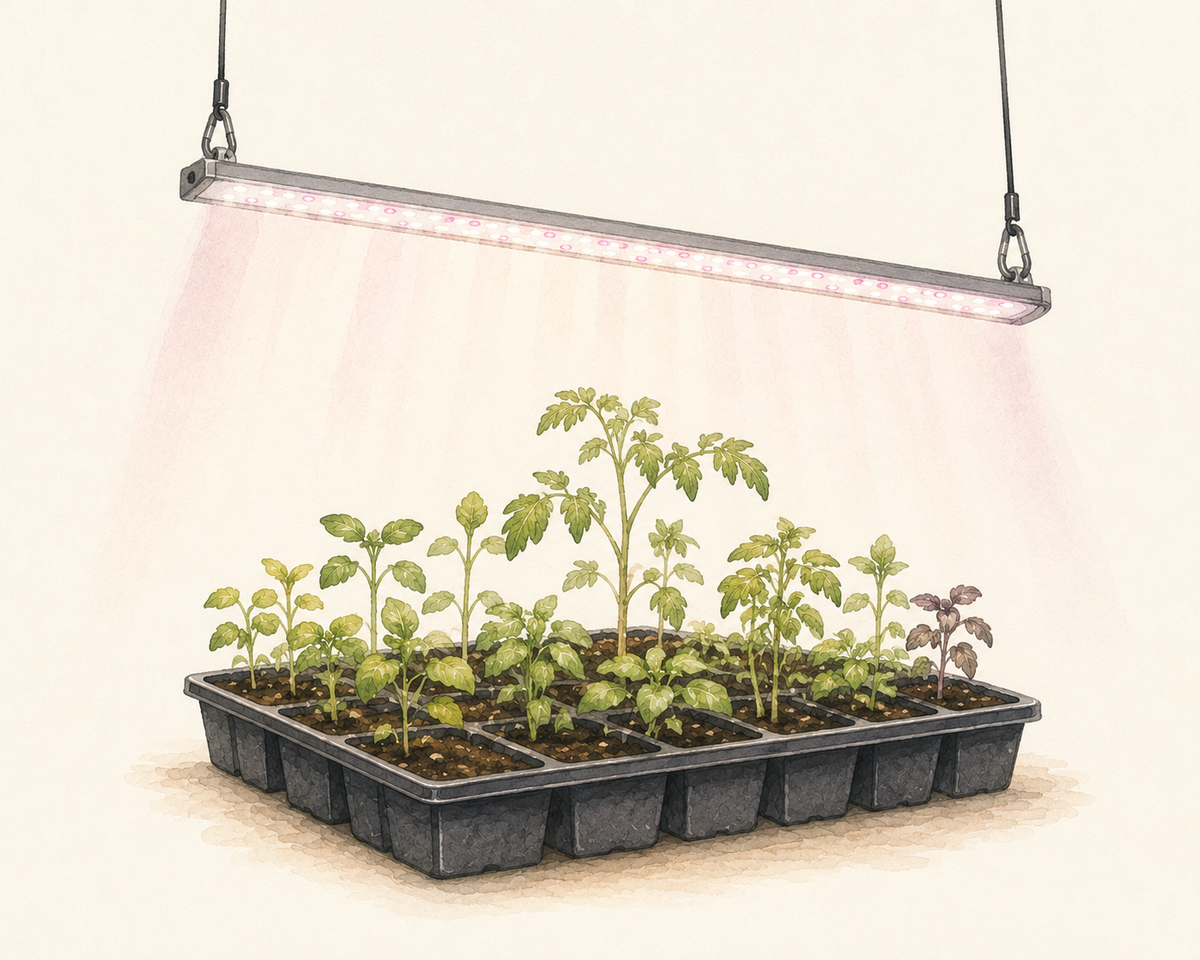
In February a window in northern Europe gives a fraction of the light a plant needs to grow compact. That is why seedlings turn leggy and pale even though they look healthy. A grow light fixes it, but only if three things are right: the intensity, the distance and the number of hours. Here are the numbers for all three.
How much light plants actually need
Light for plants is measured in micromoles per square metre per second, shortened to PPFD. It is the number of light particles hitting the leaf surface, and it is the figure the makers of good grow lights state.
| What you are growing | PPFD | Hours per day |
|---|---|---|
| Seedlings and young plants | 100 to 200 | 14 to 16 |
| Herbs and leafy greens | 200 to 400 | 14 to 16 |
| Chilli, pepper and tomato indoors | 400 and up | 16 to 18 |
| Houseplants that should thrive | 50 to 150 | 10 to 12 |
If a lamp gives no PPFD figure it is usually an ordinary household bulb sold as a grow light. It is enough for a pelargonium on a windowsill, not for a tomato plant.
Distance matters more than wattage
Light falls off with the square of the distance. Halve the distance and the light on the leaf goes up four times. That is why a weak lamp close to the plant beats a strong lamp far away.
LED bar of 15 to 30 W: 20 to 40 cm above the plants.
LED panel of 50 W and up: 40 to 60 cm.
Fluorescent tubes: 15 to 25 cm, they never get hot enough to scorch.
Then adjust to the plant rather than to the table. Leaves that go pale in the middle or cup upwards mean the lamp hangs too close. A plant reaching towards the lamp on long bare stems means it hangs too far away.
Hours per day and why darkness matters
Seedlings and young plants want 14 to 16 hours of light. Do not run the lamp around the clock. Plants respire and move sugars at night, and several species need darkness to set buds. Allow at least six hours of darkness every day.
Buy a timer. Remembering to switch a lamp on and off twice a day for three months does not work, and uneven lighting gives uneven plants.
Which lamp to choose
LED: the first choice today. Low heat, long life and the most light per watt. A good horticultural LED sits at 2.0 to 3.0 micromoles per joule.
Fluorescent tubes: still fine over a propagation bench. Cheap to buy, but the tubes dim after a couple of seasons and need replacing.
Metal halide: plenty of light, but also plenty of heat and high consumption. Overkill at home.
Ordinary incandescent bulb: around 95 percent heat and almost no usable light. Do not use one.
White or purple light
The purple lamps combine red and blue, the colours chlorophyll absorbs most of. That is efficient per watt. The drawback is that you cannot see the plants properly, and purple light in a living room is hard to live with.
White full-spectrum light at 3000 to 4000 kelvin works at least as well in practice, and you spot aphids and yellowing leaves in time. If the lamp will stand in a room you use, choose white.
Lux and lumens measure the wrong thing
Many lamps are rated in lux or lumens. Both are weighted for the sensitivity of the human eye, and the eye is most sensitive to green light, which is what the plant uses least of. A lamp can therefore look bright and still give the plant very little.
To compare two lamps, compare micromoles per joule or PPFD at a stated distance. Where those figures are missing, compare wattage within the same lamp type.
What it costs to run
A 20 W LED bar running 14 hours a day uses 0.28 kWh per day. Run it from the start of February to the end of May, about 120 days, and that is roughly 34 kWh. At 0.25 euro per kWh the whole sowing season lands at about 8 euro.
Electricity is rarely the deciding factor. The purchase price and where the lamp fits are.
Signs of too little and too much light
| What you see | What it means | What to do |
|---|---|---|
| Long pale stems with wide gaps between leaves | Too little light | Lower the lamp or extend the hours |
| The plant leans to one side | Light is coming from the side | Centre the lamp and turn the tray every other day |
| Pale patches in the middle of the leaf | The lamp hangs too close | Raise it 10 cm at a time |
| Leaves cupping upwards | Too much intensity, or too dry | Raise the lamp and check the compost |
| Leaves yellowing from the bottom despite good light | Nutrient shortage, not light shortage | See the guide to plant nutrition |
When you need the lamp and when you do not
Sowing in February or March means you need to supplement. From the middle of April a south-facing window is usually enough, and by May the lamp can go off. Winter sowing outdoors needs no lighting at all, which is one of the points of the method.
To start chilli or peppers a lamp is effectively a requirement, because they have to be sown in February to ripen in time. More crops that benefit from an early start are among our seeds for early sowing, and several of our herb seeds can be grown under a lamp all year round.
Author: Emma Vogiatzi
Fact checked by Erik Hoekstra
Last updated 2026-08-31