
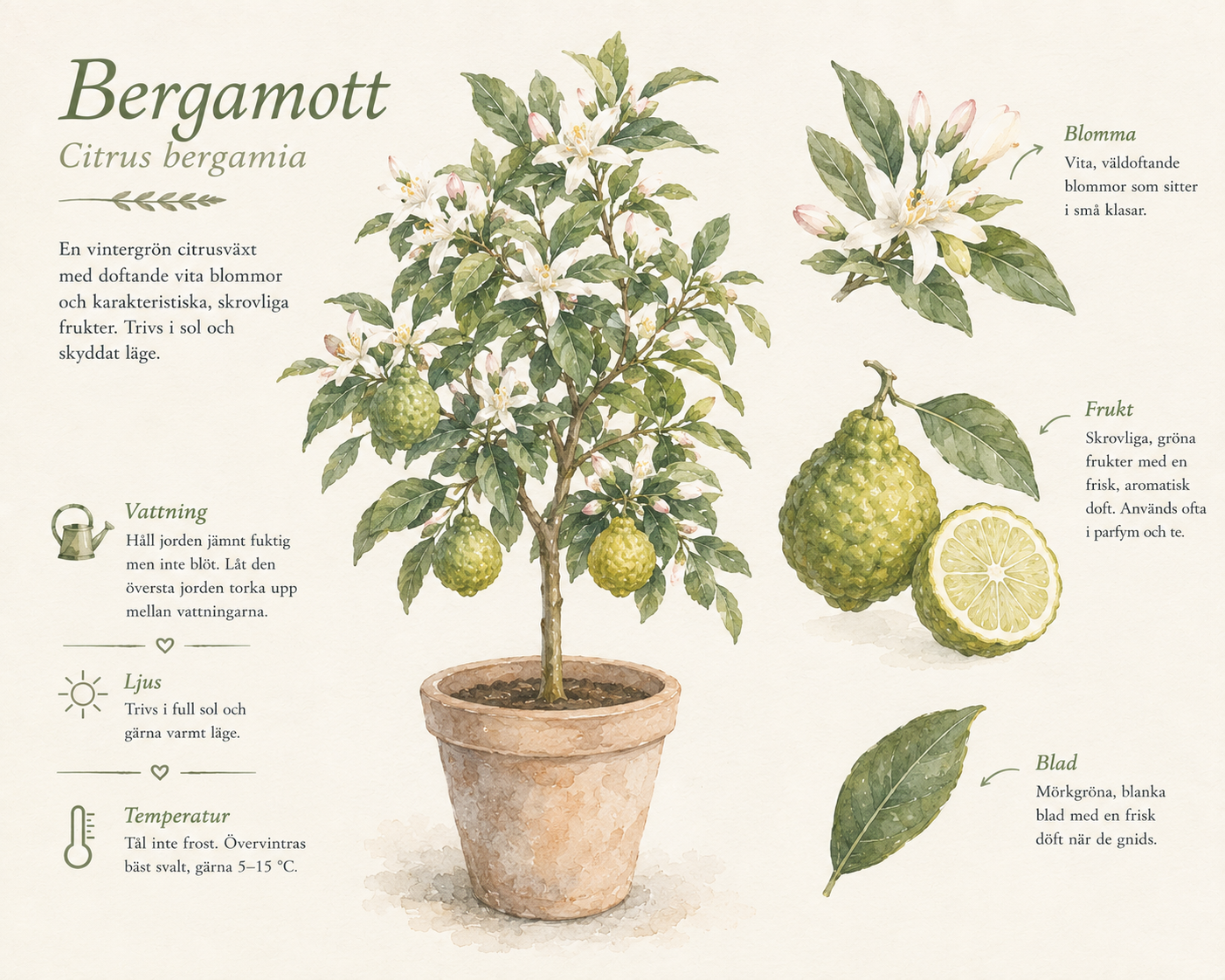
Bergamot (Citrus bergamia) is a small citrus tree from Calabria whose peel gives the oil in Earl Grey. Outside the Mediterranean it is grown in a pot, outdoors in summer and cool indoors in winter. In a pot the tree reaches 1 to 2 metres, flowers white and strongly scented in spring and ripens its pear-shaped yellow fruit between November and January. How you overwinter it decides whether it works.
Compost and pot
Compost: citrus or Mediterranean compost, acidic to slightly acidic at pH 5.5 to 6.5. Ordinary potting compost is too heavy and too limy.
Drainage: a layer of clay pebbles at the bottom and plenty of drainage holes. Citrus takes drought but not wet roots.
Pot: start with 15 to 20 litres. Change the compost every two to three years in spring and go up only one size at a time.
Weight: choose a pot you can move twice a year, or stand it on castors.
Outdoors in summer, but gradually
Move it out when nights stay reliably above 5 degrees, usually mid to late May. Stand the tree in shade for the first 10 to 14 days and then move it into full sun in stages.
Rush it and the leaves scorch. The damage shows as pale, papery patches in the middle of the leaf blade and stays for the rest of the season.
Through the summer bergamot wants as much sun and warmth as it can get. A south-facing wall on a balcony or terrace is the best place. There is more advice for that kind of spot in our article on growing on a balcony.
Watering and why tap water yellows the leaves
Water when the top 3 cm feels dry, in practice every other day through a warm summer week. Water right through until it runs from the base and tip the excess out of the saucer.
If the leaves turn yellow between the veins while the veins themselves stay green, it is almost always iron deficiency. The cause is rarely a lack of iron in the compost, but limy tap water raising the pH so the tree cannot take up what is there.
Use rainwater when you can.
Give chelated iron a couple of times over the summer.
Replace the compost every second year rather than just topping it up.
Feeding
Give citrus feed once a week from April to September. From October to March give none at all, because the tree is standing cool and not growing. Feeding a dormant citrus produces long pale shoots that snap. We go through the differences between fertilisers in our guide to plant nutrition.
Overwintering is the critical part
Bergamot takes no frost at all. Bring the tree in when nights head towards 5 degrees, usually some time in October.
Temperature: 6 to 12 degrees. An unheated conservatory, a cool hallway, a garage with a window or a stairwell all work.
Light: as bright as possible. Warm and dark together is what makes the tree drop every leaf in January.
Water: about once a month, just enough that the root ball does not dry out completely.
Feed: none.
If a warm room is all you have: give the tree the brightest place you have and add a grow light. A tree kept warm keeps growing and then needs both light and water as if it were summer.
Pruning
Bergamot needs little pruning. Cut in February or March, just before growth starts.
Take out branches that grow inwards or cross each other, and shorten shoots that break the outline back to just above a leaf. Water shoots, the long straight ones heading vertically, come off completely. Never take more than a quarter of the crown at one time.
Flowering, harvest and what the fruit is for
Flowering comes mainly in spring and the scent is strong. The fruit then hangs on for a long time and ripens from green to yellow between November and January. A tree in a pot rarely gives more than a handful of fruit a year.
The juice is too sour to drink neat but works like lime. The peel is the point: grated zest gives the same scent as in Earl Grey and suits baking and marinades.
The oil in the peel contains bergapten, a compound that makes skin light-sensitive. Get fresh juice or peel oil on your hands and then go into the sun and you can get redness. Wash your hands with soap after handling it.
Pests indoors
Scale insects: small hard brown shields along the leaf veins and branches, often with sticky honeydew underneath. Scrape them off with a fingernail and wipe with soapy water weekly for a month.
Spider mites: fine webbing in the branch forks and a yellow-speckled leaf surface. They arrive in dry warm winter air. Shower the tree and raise the humidity.
Aphids: on new shoots in spring. Rinse them off with water.
Check the tree carefully before you bring it in for the winter. That is when the pests come in with it.
The same logic as other tender pot plants
Bergamot is handled much like any plant that stands outside in summer and overwinters frost free. If you want to keep a chilli plant for another year, nearly the same applies: cool, bright and almost no water. For more scent and flavour from your own growing, look at our herb seeds.
Author: Emma Vogiatzi
Fact checked by Erik Hoekstra
Last updated 2026-08-31