
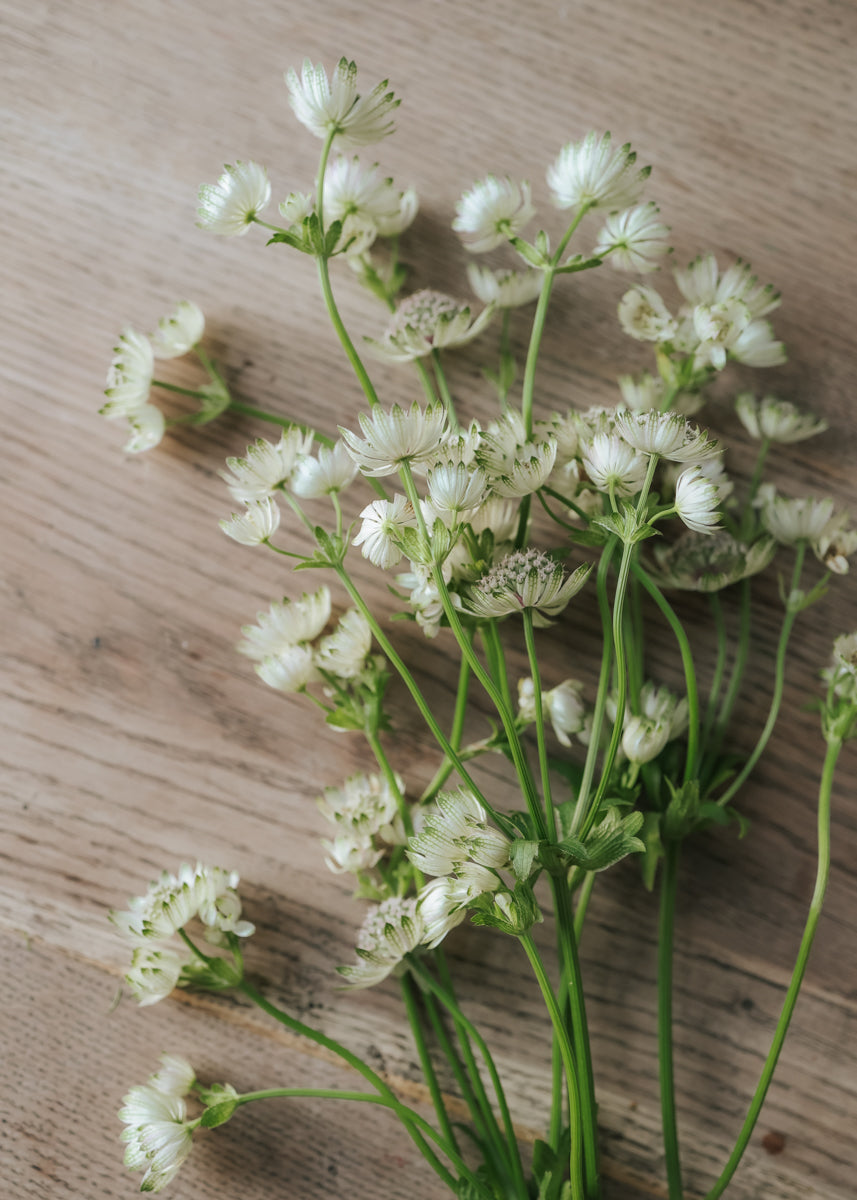
Masterwort (Astrantia major) is one of the few perennials that flowers freely in partial shade. The blooms sit in small star-shaped collars on stems 40 to 80 cm tall, they last over a week in a vase and they draw pollinators through June and July. Two things decide whether you succeed: the seed needs a cold period before it germinates, and the soil must never dry out.
The seed needs cold to germinate
This is where most people give up. Masterwort seed germinates poorly or not at all if you simply sow it warm indoors. It needs a cold spell first, the way it gets one outdoors.
You have two routes:
Sow outdoors in autumn. Sow in October or November in a pot or tray that stays outside all winter. The cold does the work for you and the seedlings appear in spring.
Cold stratify in the fridge. Mix the seed with slightly damp sand or vermiculite in a bag and keep it at around 2 to 5 degrees for four to six weeks. Then sow in seed compost at 15 to 18 degrees.
Germination is slow and uneven even after the cold period. Allow three to six weeks and do not throw the tray out too early. Keep the compost evenly moist throughout.
Position and soil
Masterwort wants partial shade or morning sun. In full sun the flowering season is shorter and the leaf edges scorch. In deep shade the plant turns sparse.
The soil should be rich in humus and hold moisture without staying waterlogged. Work in compost or leaf mould before planting. A spot under a light tree canopy or on the north side of a shrub border suits it well.
Drought is the masterwort's worst enemy. A plant that dries out mid flowering will recover, but the flowering is over for that season.
Planting masterwort
Plant in spring or early autumn. Leave 30 to 40 cm between plants so they knit into a continuous patch after a few years without competing.
Set the plant at the same depth it sat in the pot, water generously and mulch around it with compost or leaves. The mulch holds moisture, which is exactly what it wants.
Cut back for a second flush
Masterwort flowers from June into August. When the first flush starts to fade you can cut the whole plant back to about 10 cm above ground.
Water and give a little feed after cutting back. The plant pushes fresh foliage and often flowers again in September, with fewer blooms. It is a simple move that few gardeners use.
If you would rather have self sown seedlings, leave some flower stems standing. Masterwort seeds itself readily, but the seedlings rarely match the parent plant.
Dividing and propagating
Divide the clump every four to five years, in spring or early autumn. Lift the whole plant, split it with a spade or knife into pieces that carry both roots and shoots, and replant straight away. Water it in well.
Division is also how you keep a named variety. If you want exactly the same colour as the parent plant, divide rather than sow.
Masterwort as a cut flower
Cut when about two thirds of the small florets in the collar have opened. Cut too early, it opens poorly in the vase.
Cut at an angle with clean snips and put the stems straight into cold water. Vase life runs to seven to ten days. Masterwort dries well too: bundle a few stems and hang them upside down somewhere dry and airy.
We carry two varieties that work well for cutting, Masterwort Rose in pink and Masterwort White in white. More species for the bouquet are among our seeds for cut flowers.
Common mistakes
Sowing warm with no cold period. The seed rarely germinates. Stratify first.
A spot that is too sunny and too dry. Flowering is brief and the leaves scorch at the edges.
Throwing the tray out too soon. Germination is uneven and can stretch over six weeks.
Leaving every flower stem standing. No second flush, and the plant puts its energy into seed.
Masterwort pairs well with other perennials that take partial shade. There is more in our articles on perennials and on cut flowers.
Author: Emma Vogiatzi
Fact checked by Erik Hoekstra
Last updated 2026-08-21