
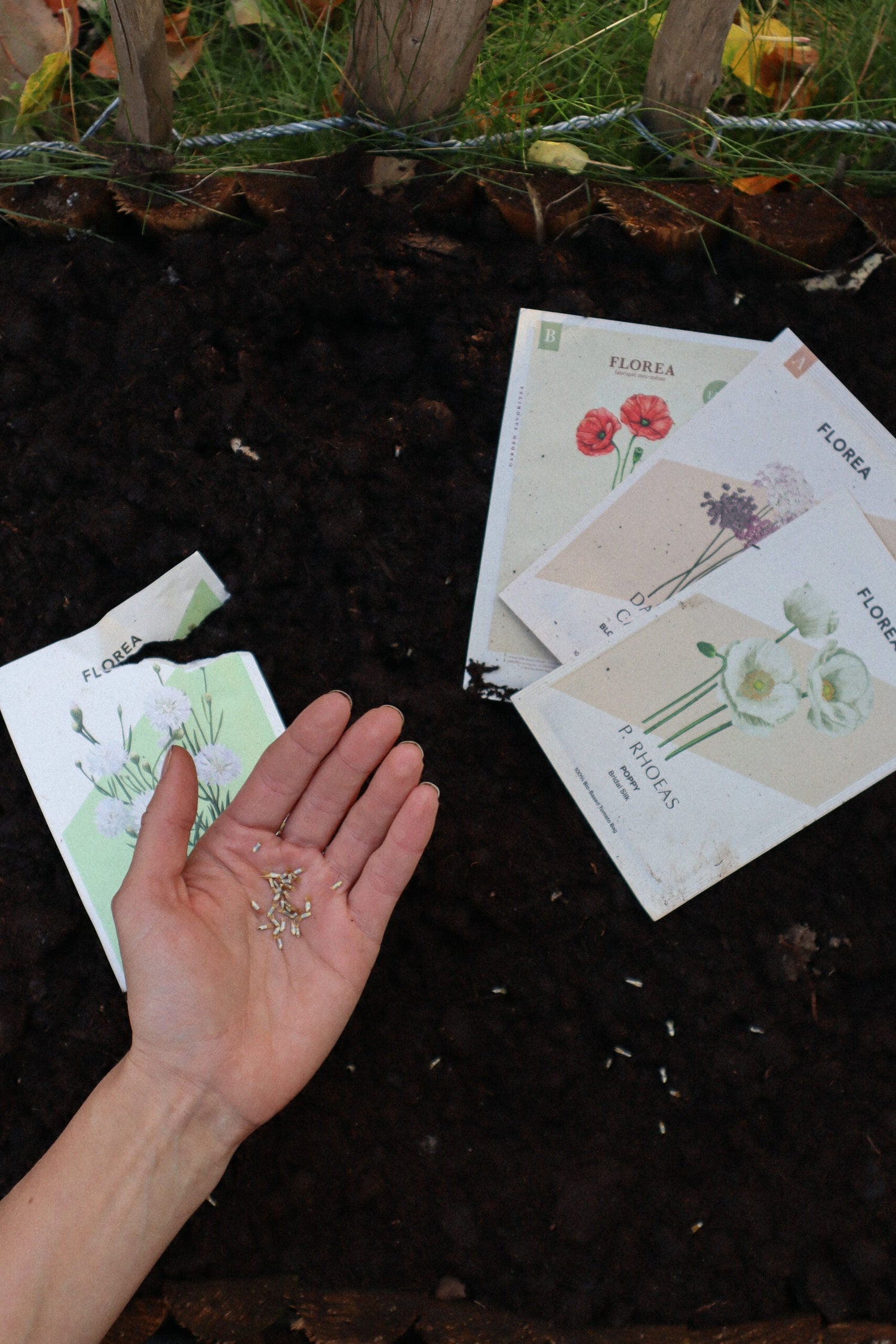
Autumn sowing
When the cold creeps in and the days grow shorter, it is easy to assume that the sowing season is over. It isn't. October and November are prime time for autumn sowing, a welcome job for everyone who loves growing, wants to keep things simple and would like a head start on next season. We at Florea have gathered our best tips on how to go about it, along with a guide to the varieties that suit autumn sowing perfectly.
Sowing in autumn is nothing new. It was very common in the days when farmers needed to squeeze as many harvests as possible out of the year. It is less widespread today, but as food prices rise and interest in home-grown produce grows, this lovely technique is enjoying a real revival.
How does autumn sowing work?
Autumn sowing means the seeds go into the ground and rest there through the winter, then start to germinate in spring as the weather warms up. Timing matters. If the weather is still too mild when you sow, the seeds risk sprouting straight away. Aim to sow as late as possible, but before the ground freezes. In colder regions that usually means October, while in milder areas November is the right time. The biggest threat to the seeds is not the cold, as many believe, but wet, so choose a spot with good drainage.
Why sow in autumn?
There are many advantages to autumn sowing. The main one is earlier flowering, or being able to harvest the very first tender crops in May and June. It is also remarkably simple, and it is satisfying to have some varieties sown and done before winter so that spring can be devoted to the crops that need more attention.
How to sow in autumn, step by step
- Start by clearing the bed of every weed before the seeds go in. Weeding becomes difficult once the ground freezes, and doing it in spring risks damaging the young plants. You also give your seedlings the best possible start, since they avoid competition for root space.
- For the best result, enrich the soil with compost or well-rotted manure. If you don't feed the soil in autumn, it becomes even more important to do so in spring once the plants are up, and to give them an extra boost now and then.
- Rake the soil level so you have a reasonably even seedbed. Then draw one or more drills, depending on how much you are sowing. Sow at the correct depth, row spacing and plant spacing, which you will find on the back of your seed packet.
- Cover the sowing gently with soil and water lightly so the seeds are just moist. Once done, the bed can be given extra protection with a winter mulch of leaves, spruce twigs or another natural covering.
- When the plants finally start to germinate in spring, remove the mulch carefully so the seedlings reach the light.
Which varieties can be sown in autumn?
Autumn sowing only suits seeds that tolerate cold. Below is a list of vegetables, herbs and flowers that are particularly well suited to it.
Vegetables and herbs
- Carrot
- Winter radish (Raphanus sativus var. longipinnatus)
- Parsnip
- Radish
- Beetroot (tricky, but easier in milder areas)
- Black salsify (Scorzonera hispanica)
- Parsley
- Dill
- Chives
- Spinach
- Lettuce
- Onion grown from seed (not sets)
Flowers
- Pot marigold (Calendula)
- Cornflower
- Poppy
- Larkspur (Consolida ajacis)
- Bishop's flower (Ammi majus)
- Breadseed poppy (Papaver somniferum)
- Oxeye daisy
- Love-in-a-mist (Nigella)
- Wild carrot (Daucus carota)
Author: Johanna Damm
Fact-checked by Erik Hoekstra
Last updated 2024-10-28