
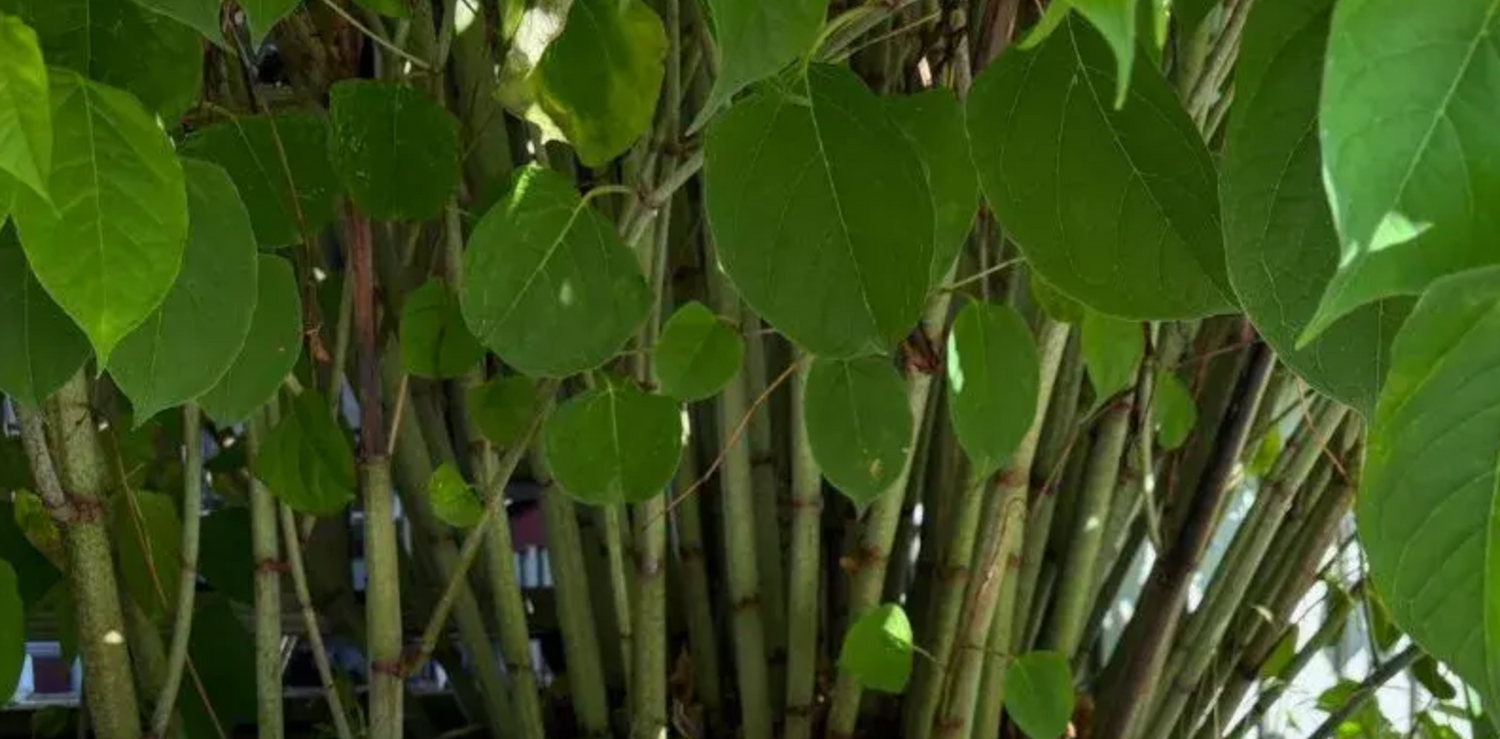
Park slide
Parkslide is a plant that originally comes from Japan but has been found wild in Sweden for more than 100 years. Parkslide was imported as an ornamental plant for parks and gardens. It grows very quickly. So quickly that the species can become invasive and cause problems if a population is not kept under control. In the worst case, Parkslide shoots can damage buildings and infrastructure through their vigorous growth habit.
Parkslide thrives in many different environments
Parkslide is a hardy plant that can handle everything from wet soil to drought. In Sweden, parkslide thrives in meadows and forest edges. One of the reasons why parkslide can quickly outcompete other plants is that it has a substance in it that inhibits the growth of other plants. In Japan, where parkslide originated, there are natural enemies of the species. Where these are lacking, parkslide can become a major problem. Not least in the UK, the plant causes economic damage by lowering the value of properties where it grows. Not everyone wants to take on the rather large task of getting rid of parkslide.
Parkslide – characteristics
Here is a checklist for those of you who are unsure how to identify a park slide:
- Parkslide is a perennial herb with a bamboo-like growth habit that can grow 50–250 cm tall.
- The stem is rough and hollow and slightly woody.
- The egg-shaped leaves are 5–15 cm long with a distinct tip and straight base.
- Parkslide has pink or white flowers in sparse clusters that bloom in late summer or autumn.
- The roots go very deep into the ground.
Rosenslip is a plant similar to parkslip but is not as invasive. Giant slipper, another relative, spreads in the same aggressive manner as parkslip.
For those of you who need to combat park slides
There are several ways to combat parkland creeper. The most effective method is to dig up the plants with the roots. It is laborious, but the results are permanent if you really get all the root parts. Cutting down parkland creeper plants can limit their spread. If you constantly remove young shoots, the stock will tire out over time and it may disappear completely in the long run. Cutting down a stock and covering it with ground cloth can help. Feel free to use more than one layer of cloth if you want to try this method. It is important to take care of plant parts in a way that does not contribute to further spread. Placing them in the municipality's containers for invasive species or for combustible waste is better than trying to compost or burn parkland creeper on the property. There are pesticides that help against parkland creeper. Glyphosate can be very effective. However, as a private individual, you are not allowed to use glyphosate to combat parkland creeper in your garden. The substance is toxic and, just like parkland creeper, can have a negative impact on biodiversity. Vinegar may be an alternative, but repeated treatment lowers the soil's pH. In that case, digging up or tiring out the stand is a better option. There have also been attempts to combat park landslides with road salt. However, the salt affects all life in the soil and the method is not permitted today.
Author: Johanna Damm Fact-checked by Erik Hoekstra Last updated 2025-11-09