
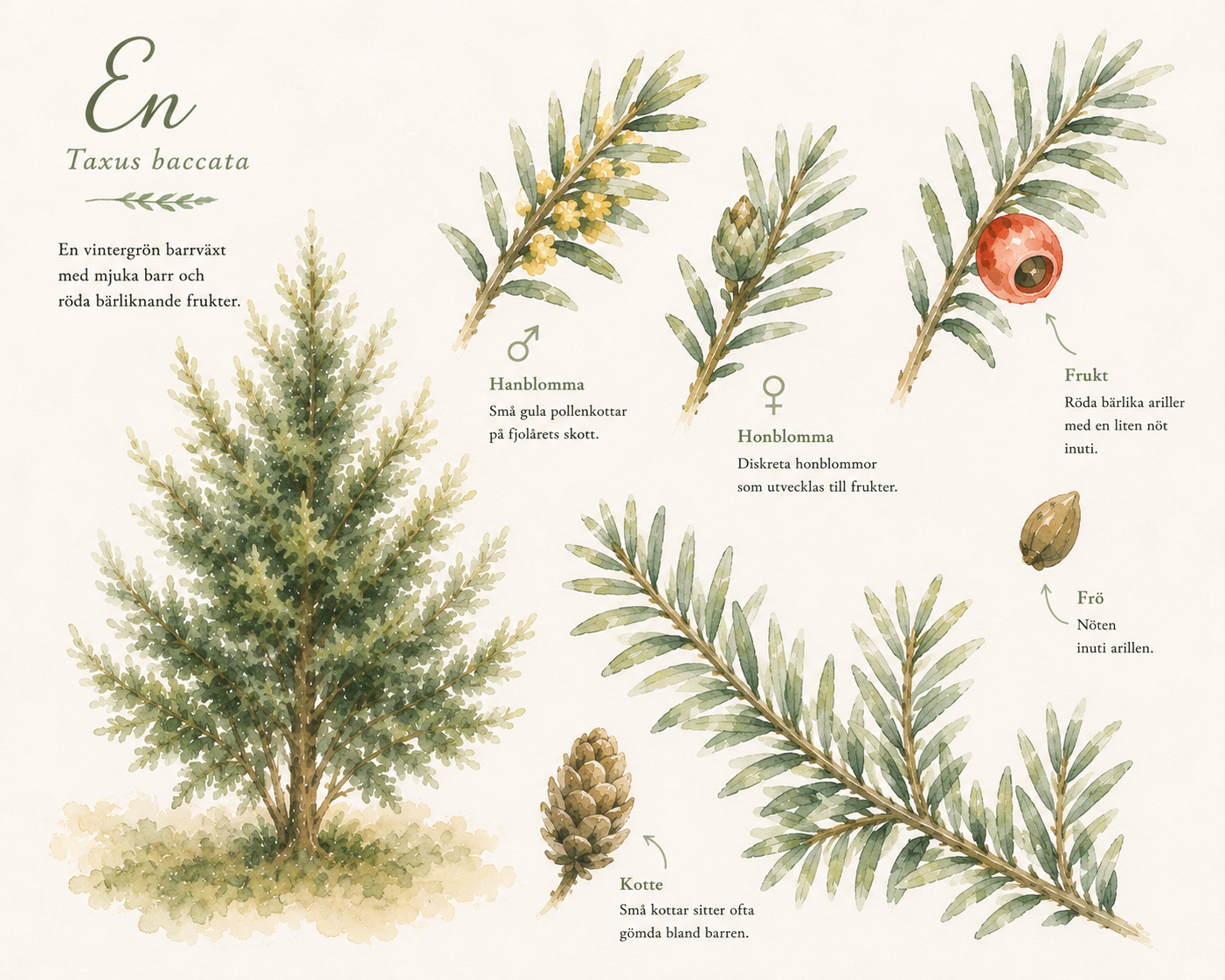
Juniper (Juniperus communis) is one of the most widely distributed conifers in the world and grows wild across most of the northern hemisphere, from coastal rock to mountain woodland. In the garden it is tough in a way few evergreens are: it copes with poor dry soil, salt wind and hard frost. Two things are worth knowing before you plant. Juniper grows slowly, and it does not break new shoots from old wood.
Position and soil
Give juniper full sun. In shade it grows open and loses the dense shape you planted it for.
The soil should be free draining and preferably poor. Sand, gravel and stony ground all work well. The one thing juniper will not take is wet ground. If water stands after rain it is the wrong spot, or you plant on a raised bed.
Juniper handles windy and coastal positions where other plants are cut down. It also carries snow load without breaking, which makes the columnar forms useful in cold regions.
Forms to choose between
Choose by shape, because the shape decides where the plant earns its place.
Columnar: Hibernica and Suecica grow narrow and upright and reach three to four metres in time. Used as vertical accents in a border or as a backdrop.
Ground covering: Repanda stays only 30 to 50 cm tall but spreads a couple of metres. Good on slopes and where you would rather not weed.
Bushy: the ordinary wild form makes an irregular shrub of one to three metres. Suits a naturalistic garden.
Expect slow growth whatever you choose, often 5 to 15 cm a year. Buy the size you want, because the wait is long.
Planting juniper
Plant in spring or early autumn so the roots establish before winter.
Dig a hole twice as wide as the root ball. The depth should match the ball, no more.
Mix the excavated soil with grit if you have heavy clay. If you do not need to feed, do not feed.
Set the plant at the same depth as in the pot and fill in.
Water generously at planting and keep the soil moist through the first season.
After the first year an established juniper almost never needs watering. It takes drought better than most conifers.
Pruning: never cut into the brown wood
This is the rule that decides whether the plant stays presentable. Juniper does not break new shoots from old brown wood. Cut into the brown part inside the bush and you get a bare hole that never closes.
Cut only in the green, needled growth at the outside. Take a little every year rather than a lot at once. The best time is early summer, once growth has started.
Formal clipping is rarely needed. If you want a plant that takes hard shaping, box is a better choice, and for hedges there is our article on hedges.
Juniper berries need a female plant and patience
Juniper carries male and female flowers on separate plants. Only the female plant bears berries, and it needs a male plant nearby for them to be fertilised.
The berries also ripen slowly. They stay on the bush for two to three years and turn from green to blue-black. That is why you see green and ripe berries on the same bush at the same time.
Pick only the soft, blue-black berries, best in autumn. Wear gloves, the needles prick. Dry the berries somewhere airy for a few weeks and store them dry and dark.
Pear rust and other problems
Juniper is otherwise healthy, but one thing is worth knowing before you pick a variety. Some junipers, above all savin juniper (Juniperus sabina), host European pear rust. The fungus alternates between juniper and pear and puts orange spots on pear leaves in summer.
If you or a neighbour have a pear tree: leave savin juniper out and keep distance between junipers and pears. Orange, jelly-like growths on juniper branches in spring are the rust, and those branches should be cut out.
The other common problem is roots that have stood wet. The needles yellow and branches die back from the inside. It cannot be fixed with water or feed, it is about drainage on the site.
Author: Emma Vogiatzi
Fact checked by Erik Hoekstra
Last updated 2026-08-21