
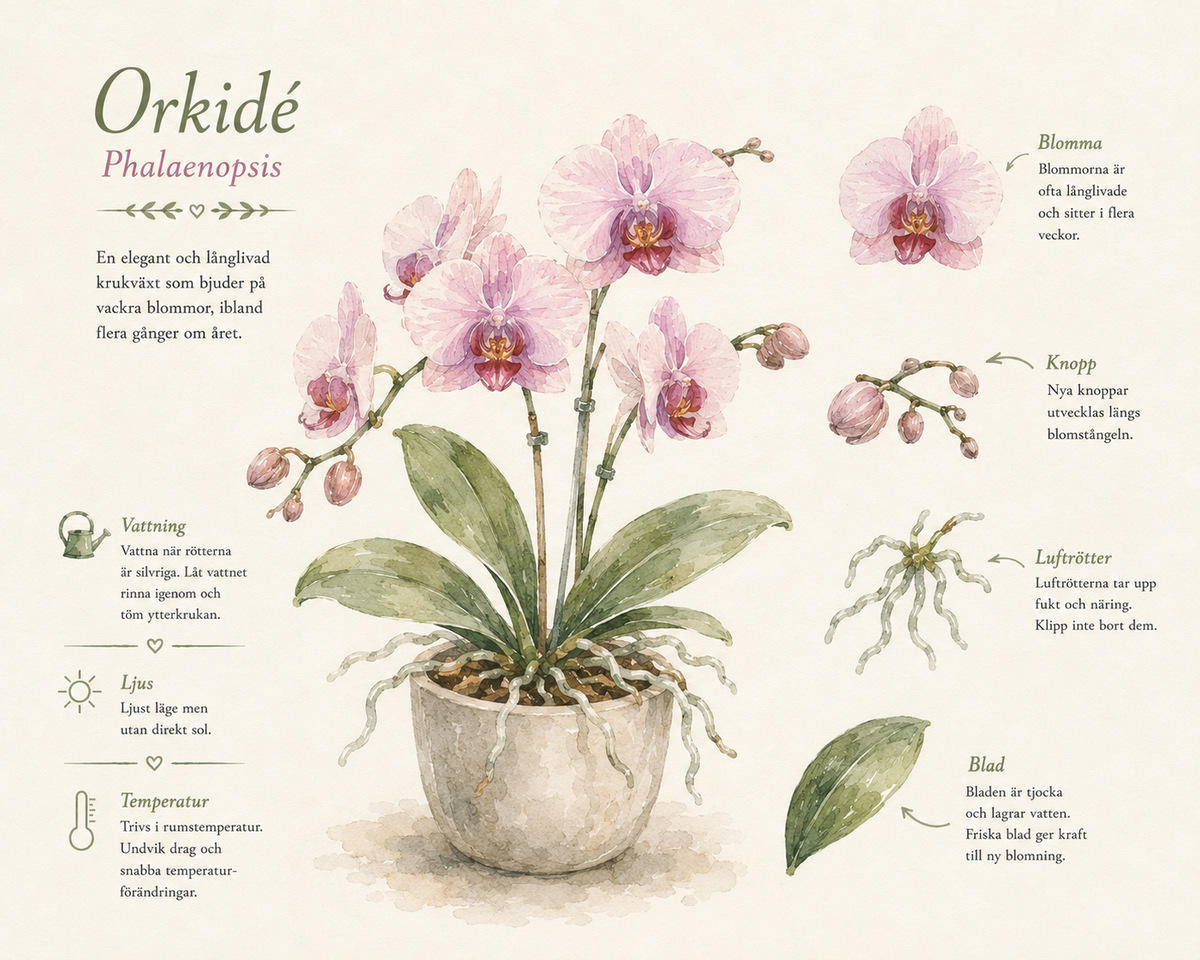
Almost every orchid sold in shops is a moth orchid, Phalaenopsis. It is an epiphyte that grows attached to tree trunks in the wild, and that explains most of the care: the roots want air and light, not compost. A plant that is doing well flowers for two to four months at a time and can flower again every year for ten years or more.
Water by dipping
Stand the inner pot in a bowl of tepid water so the bark is covered. Leave it 10 to 20 minutes, lift it out and let it drain properly before it goes back into the outer pot.
Interval: every seven to ten days in summer, every ten to fourteen in winter.
Never standing water: tip out whatever collects in the outer pot. Roots left in water rot within days.
No ice cubes: the tip appears everywhere but chills roots that come from the tropics.
The water: room temperature, ideally rainwater or tap water that has stood out for a day.
Read the roots
The inner pot is transparent for a reason. Root colour tells you exactly when it is time.
Silvery grey roots: dry, time to water.
Bright green roots: saturated, wait.
Brown, mushy roots: root rot. Repot and cut away everything soft.
Roots growing out into the air: completely normal. Do not cut them and do not force them into the pot.
Light and temperature
A bright spot without direct midday sun. An east window is usually best. In a south window you need a sheer curtain between April and September. Leaves that go dark green and floppy mean it is too dark, leaves that go yellowish and hard mean it is too bright.
A day temperature of 20 to 25 degrees and a night temperature of 18 to 20 works all year. Avoid the spot directly above a radiator, and avoid draughty windowsills in winter.
How to make it flower again
This is the part that usually gets left out, and it is the part that settles the matter. Phalaenopsis only sets new flower spikes after a spell of cooler nights.
Put the plant where nights sit at 15 to 17 degrees while the day holds 20 to 22. A bedroom or a cool spare room works.
Keep the difference between day and night at a minimum of 5 degrees.
Leave it there for four to six weeks. Water as usual but give no feed.
When a new spike is 5 to 10 cm, move the plant back to its usual place and start feeding again.
September and October are the natural time to do it, since the nights cool down anyway.
What to do with the stem after flowering
Look at the colour of the stem before you cut.
Still green: cut above the second or third node counting from the bottom. The nodes are the small rings on the stem. A side spike often comes from there within a couple of months.
Yellowed or brown and dry: cut it off at the base, about 1 cm above the leaves. That stem will give nothing more.
Use clean, sharp snips and wipe the blade between plants.
Repotting: the bark is the problem, not the pot
An orchid is not repotted because it has outgrown the pot, but because the bark breaks down. Decomposed bark compacts, holds water and suffocates the roots.
Change it every two to three years, ideally right after flowering. Use orchid bark, never potting compost. Shake off the old bark, cut away soft roots and put the plant back in a transparent pot that barely holds the root mass.
Feeding
Give orchid feed at half strength every third watering from March to September, and about once a month for the rest of the year. Too strong a dose burns the root tips, which shows as black ends. Flush the bark through with clean water once a quarter to wash out salt residues.
Symptom and cause
| What you see | Likely cause | What to do |
|---|---|---|
| Buds dry up and drop before opening | Ethylene from ripening fruit nearby, draught or a sudden move | Move the fruit bowl away and leave the plant where it is |
| Limp, creased leaves | The roots are not taking up water, usually root rot | Check the roots and repot in fresh bark |
| The lowest leaf yellows and drops | Normal, one leaf at a time | Nothing to do |
| Several leaves yellow at once | Too much water or too much sun | Review watering and position |
| No new flower spikes for over a year | No cool spell | Give it four to six weeks of cool nights |
For more plants that cope with the same window, see our articles on houseplants, monstera and coleus. If the window is dark in winter, a grow light helps.
Author: Emma Vogiatzi
Fact checked by Erik Hoekstra
Last updated 2026-08-31