
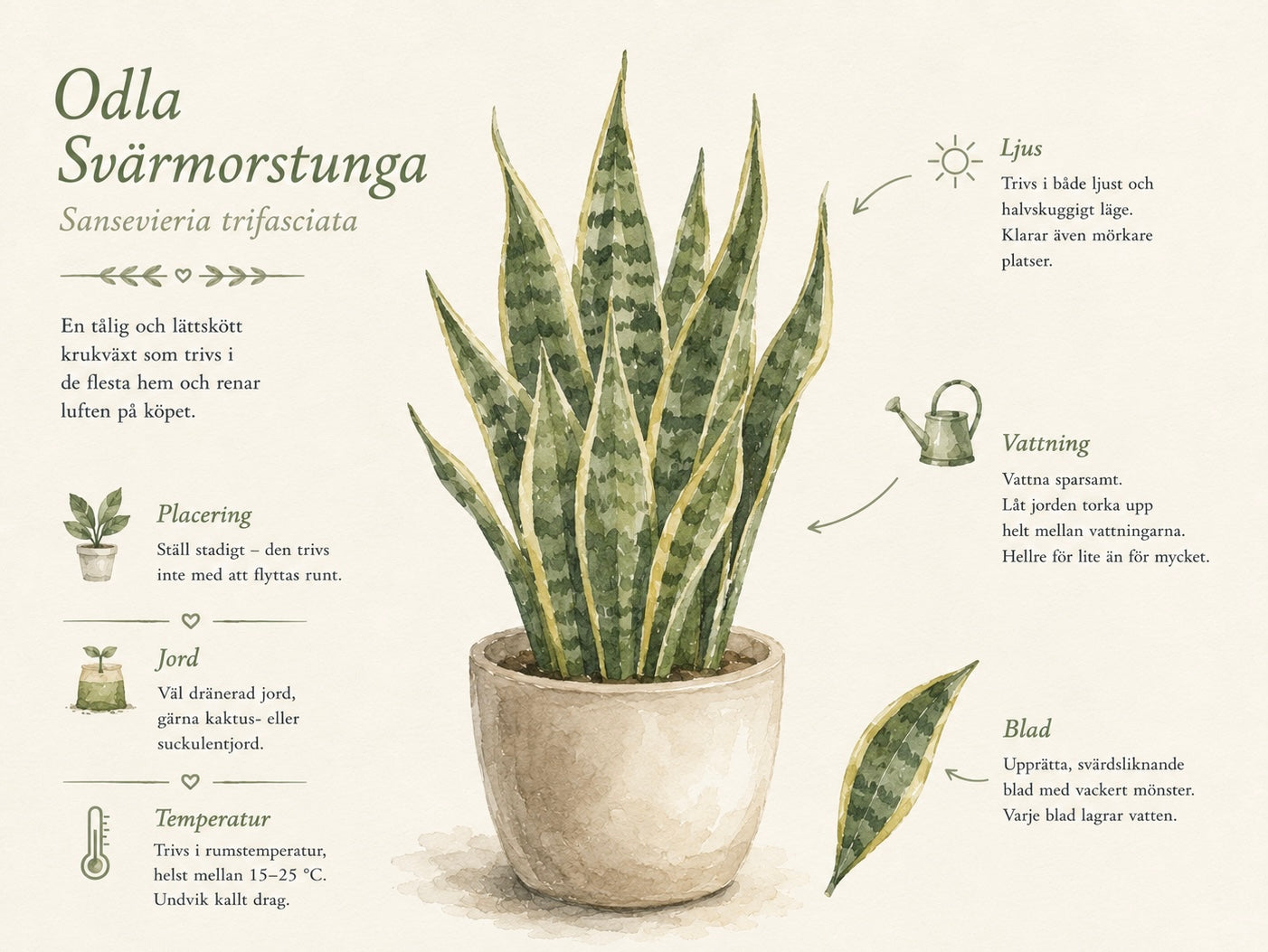
The snake plant is the houseplant that survives the most. It copes with dark corners, dry indoor air and weeks without attention. The one thing it cannot cope with is wet compost, and that is almost always the explanation when a snake plant dies. Since 2017 botanists have placed it in Dracaena as Dracaena trifasciata, though shops still sell it as Sansevieria.
Watering is the whole secret
The leaves are water stores. The plant survives drought for months, but the roots rot within weeks in constantly moist compost.
April to September: water every two to three weeks.
October to March: every four to six weeks is enough.
The test: push a finger 3 to 4 cm into the compost. If it feels even slightly damp, wait another week.
Where: water onto the compost, never down into the rosette. Water left sitting there rots the base.
Afterwards: tip out whatever collects in the outer pot after ten minutes.
Leaves that go soft and yellow at the base mean too much water. Leaves that wrinkle and crease lengthwise mean too little.
Light and position
A snake plant grows in bright indirect light and survives in shade. The difference shows in the speed: in a bright room it makes two to four new leaves a year, in a dark corner perhaps one.
Strong midday sun through glass bleaches the leaves and gives brown patches. An east or west window is ideal. Keep the temperature between 18 and 27 degrees. The plant is damaged below 10 degrees, so do not leave it in a cold window behind a drawn curtain in winter.
Compost and repotting
Use cactus compost, or ordinary potting compost mixed with one third perlite or coarse sand. The pot must have drainage holes.
The plant likes to be pot-bound and only needs moving every three to five years, preferably in spring. Choose a heavy pot in terracotta or ceramic: tall varieties become top-heavy and tip over in plastic.
Feeding
Give cactus feed at half strength once a month from April to September. No feed at all through the winter. Overfeeding gives slack, overlong leaves that bend outwards.
Propagating: divide or take leaf cuttings
There is a trap here that is rarely mentioned. The two methods give different results.
Division keeps the variety. Take the plant out, separate the rhizomes with a clean knife so each piece has both leaves and roots, and repot straight away. A variety with a yellow leaf edge stays yellow-edged.
Leaf cuttings lose the yellow edge. Cut a leaf into 5 to 10 cm sections, let the cut surface dry for a day and stand the pieces the right way up in water or damp sand. Roots come in 4 to 8 weeks and a new shoot after 2 to 4 months. That shoot comes out plain green, because the yellow stripe sits in one tissue layer of the leaf and is not passed on.
So if you want to keep a Laurentii with its yellow edge, division is the only route.
Varieties
Laurentii: the classic with yellow leaf edges, 60 to 100 cm.
Zeylanica: grey-green cross banding without the yellow edge, takes darker spots.
Moonshine: broad silver-green leaves, needs more light to hold the colour.
Hahnii: a low rosette of 15 to 20 cm, fits a shelf.
Cylindrica: round spears instead of flat leaves, often sold braided.
Toxic to cats and dogs
The leaves contain saponins. A cat or dog that chews on them can get drooling, vomiting and diarrhoea. It is rarely serious but unpleasant, so put the plant where the animals cannot reach it. For people it is enough not to eat the leaves.
About the air-purifying claim
Snake plants are often marketed as air purifying. That rests on a 1989 study in which plants were placed in small sealed chambers. Later reviews of the same data show the effect in an ordinary room is negligible compared with opening a window.
What is true is that the plant uses a form of photosynthesis that opens its pores at night rather than during the day. It therefore releases oxygen at night, unlike most houseplants. Buy it because it is tough, not because it will clean your air.
Common problems
Soft, brown base: root rot. Take the plant out, cut away everything soft, let the cuts dry for a day and repot in dry cactus compost.
Brown dry tips: cold draught or uneven watering. Move the plant away from the door.
White cottony tufts in the leaf joints: mealybugs. Wipe them off with a cotton bud dipped in rubbing alcohol and repeat weekly for a month.
Leaves falling outwards: too little light or too much feed.
For more tough green plants for the same window, see our articles on houseplants, monstera and coleus. And if you would rather have something edible on the windowsill, several of our herb seeds can be sown indoors all year round.
Author: Emma Vogiatzi
Fact checked by Erik Hoekstra
Last updated 2026-08-31