
Japanese knotweed is banned across the EU and restricted in the UK
On 7 August 2025, Commission Implementing Regulation (EU) 2025/1422 entered into force. It added 26 species to the Union list of invasive alien species of Union concern, and three of them are knotweeds: Japanese knotweed (Reynoutria japonica), giant knotweed (R. sachalinensis) and Bohemian knotweed (R. x bohemica). Listing triggers the prohibitions in Article 7 of Regulation (EU) No 1143/2014: the species may not be kept, imported, sold, bred, transported, used, exchanged, allowed to reproduce, grown or released into the environment.
There is an important nuance for anyone who has a stand in the garden. Whether a member state has to eradicate a listed species or only manage it is decided at national level, and so are the management programmes that go with it. Sweden, for example, has classified all three knotweeds as widely spread, which exempts them from the eradication requirement there, while the prohibitions still apply in full to property owners. What applies where you live is a question for your national nature conservation authority, so check before you plan any work.
The UK is not in the EU, so Regulation (EU) 2025/1422 does not apply there. Japanese knotweed is instead listed in Schedule 9 to the Wildlife and Countryside Act 1981, and it is an offence to plant it or otherwise cause it to grow in the wild. Government guidance is that you are not legally required to remove Japanese knotweed from your land unless it causes a nuisance, but you must stop Japanese knotweed on your land from spreading off your property, and you can be prosecuted for causing it to spread into the wild.
You can tackle a stand on land you own yourself. To remove one on a neighbour's land, or on land owned by the council, you need the landowner's permission.
How to identify Japanese knotweed
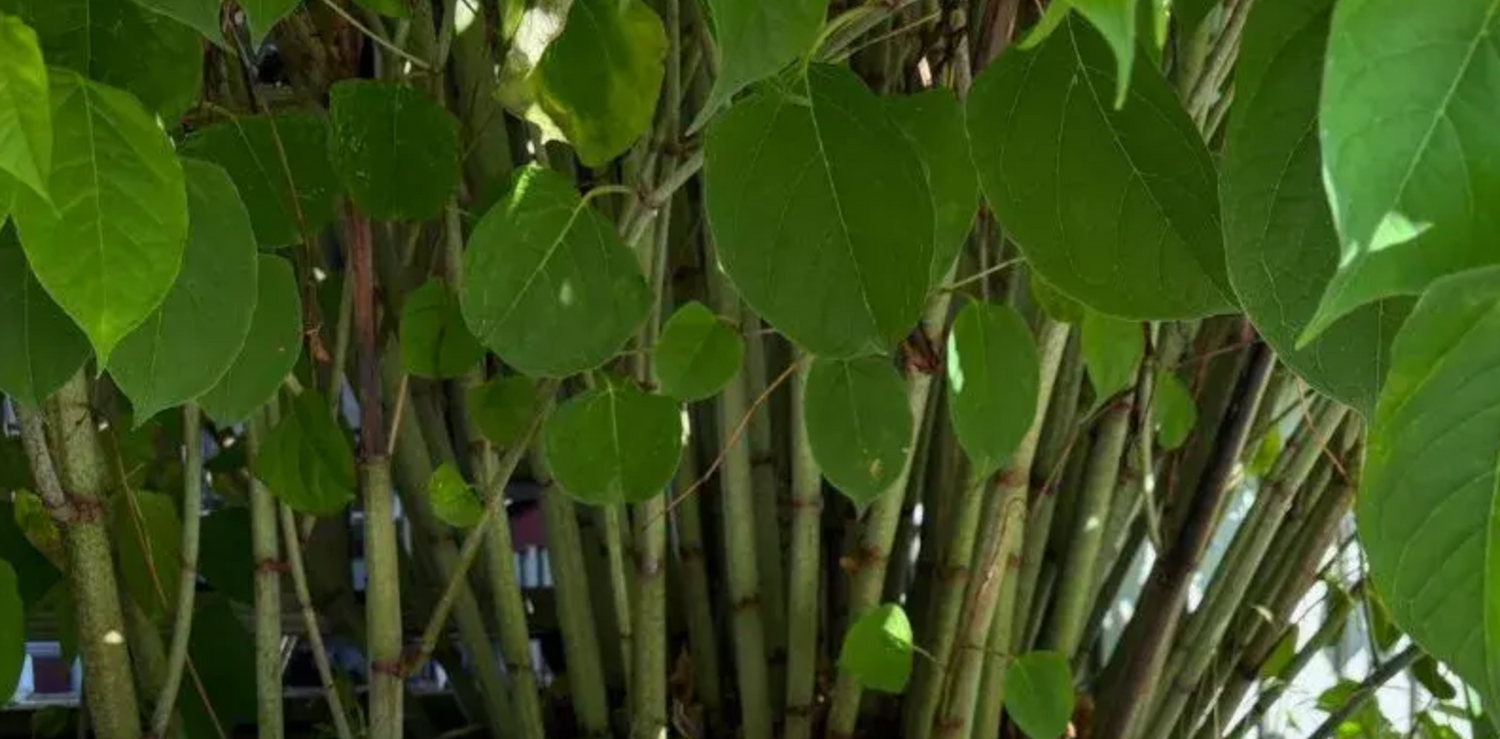
Japanese knotweed is a perennial herb with a bamboo-like growth habit. This checklist works out in the garden:
- Height 50 to 250 cm, upright and heavily branched.
- The stem is thick, hollow and slightly woody. It is light green or reddish brown, often with reddish flecks.
- The leaves are broadly oval, 5 to 15 cm, hairless on both the upper and the lower surface, leathery, with a clear point and a straight base.
- Flowering comes in September and October, with white or sometimes pink flowers in loose, branched sprays from the leaf axils.
- The rhizomes are massive, can reach 5 to 6 metres long and can grow up to a metre in a single season.
As far as is known, only female plants of Japanese knotweed occur in Sweden. Although it flowers, it cannot reproduce by seed there. All spread happens through pieces of root and stem. It is often mistaken for bamboo. Bamboo has woody canes with clear joints and narrow leaves, while Japanese knotweed has soft annual shoots and broad leaves.
Japanese, giant, Bohemian and Himalayan knotweed
The names get mixed up constantly, and that has legal consequences, because the prohibitions attach to named species. The table shows the risk classification from the 2024 risk list for alien species published by the SLU Swedish Species Information Centre, together with the status on the Union list.
| Scientific name | English name | Risk class, Sweden (SLU 2024) | Union list |
|---|---|---|---|
| Reynoutria japonica | Japanese knotweed | Very high risk (SE) | Yes, since 7 August 2025 |
| Reynoutria sachalinensis | giant knotweed | Very high risk (SE) | Yes, since 7 August 2025 |
| Reynoutria x bohemica | Bohemian knotweed | Very high risk (SE) | Yes, since 7 August 2025 |
| Reynoutria japonica var. compacta | ornamental variety of Japanese knotweed | Potentially high risk (PH) | Yes, covered by the species Reynoutria japonica |
| Rubrivena polystachya | Himalayan knotweed | Low risk (LO) | Yes, since 2 August 2022 |
The ornamental variety Reynoutria japonica var. compacta is often described as a better behaved relative of Japanese knotweed. That is wrong. It is a variety of Japanese knotweed, the same species, and because the Union list names the species Reynoutria japonica Houtt. the variety is covered by the same prohibitions. It grows lower, has pink-red flowers and smaller leathery leaves with a slightly wavy edge. The SLU Swedish Species Information Centre judges that it has high invasion potential but so far low ecological impact. It was first reported in Sweden in 1989, in Småland, and up to and including 2024 it was known from just under 40 sites, half of which have appeared since 2020.
Himalayan knotweed, on the other hand, is not related to Japanese or giant knotweed despite the name. It is also on the Union list, but since 2 August 2022.
Why Japanese knotweed is so hard to get rid of
The Swedish Environmental Protection Agency calls Japanese knotweed the hardest invasive plant to control in Sweden. The reasons are concrete:
- It establishes on almost any soil type.
- Less than one gram of root fragment is enough for a new plant to take.
- Roots can lie dormant for several years and then start to throw up shoots.
- It starts early in spring and quickly forms dense stands.
- It can respond to control work by sending root shoots up to seven metres from the parent plant, sometimes onto a neighbour's land.
- It tolerates chemical control agents better than many other species.
- The rhizomes often survive attempts to burn them.
Long distance spread happens mainly when soil containing root pieces is moved. If you buy soil, ask the supplier where it comes from and whether it is free of invasive species.
What Japanese knotweed actually does
Japanese knotweed outcompetes other plants and sometimes forms pure monocultures. That changes the habitat for amphibians, reptiles, birds and mammals. Areas can close over completely, so that it is no longer possible to walk there or to garden.
The claim that Japanese knotweed bursts house foundations comes up often. The Swedish Environmental Protection Agency is more restrained: the roots can push into buildings and water pipes, but in Sweden this is still uncommon and arises mainly in older buildings that already have cracks. In the UK, by contrast, the plant has affected property values and the ability to get a mortgage.
Methods that can work
The most important point first: the Swedish Environmental Protection Agency states that there are currently no control methods that can be recommended with certainty or guaranteed to work in every situation. A method that works in one place can increase spread in another. If you cannot carry a measure through fully, choose another method or wait until you have what you need.
- Digging out and removal. A one-off effort that can solve the problem, but it is expensive and carries several risks, both on site and during transport. Every rhizome that snaps during digging can become a new plant. Draw up a risk management plan before you start.
- Covering with ground fabric. Needs a generous margin and ground clear of trees, shrubs and buildings, otherwise the fabric cannot be sealed tightly. Count on several years and check the edges.
- Cutting and root pulling. Simple, but it has to be repeated often over many years. On a well established stand it is doubtful whether the method can be used at all, because the risk of spreading it is high.
- Heat treatment. The underground parts are treated with heat. The method uses a lot of energy.
- Glyphosate. In the EU, a plant protection product may not be placed on the market or used unless it is authorised in the member state concerned (Regulation (EC) No 1107/2009, Article 28), and each country decides who may apply it and where. In the UK, anyone spraying must hold a certificate of competence for herbicide use, you need permission from Natural England if the area is protected, and agreement from the Environment Agency if the plants are near water. Either way, treatment has to be repeated over several years.
A combination of several methods is often needed. Because Japanese knotweed creeps, the whole stand has to be treated, even where it crosses a property boundary.
Methods that are illegal or useless
Pouring petrol, diesel, hydrochloric acid, sulphuric acid, caustic soda or battery acid on Japanese knotweed is not permitted. None of them is an authorised plant protection product, and a product that is not authorised may not be used. It is also seriously harmful to the environment, and it does not work: the substances are not actively taken up by the roots, so they barely touch the rhizome.
Salt is not an authorised plant protection product either, so it may not be used as one. Japanese knotweed tolerates salt well and grows happily along salted road verges. The salt, on the other hand, wipes out soil organisms, changes the chemistry and water holding capacity of the soil and takes a very long time to wash out.
Household vinegar is not an authorised plant protection product. Where a contact weedkiller is authorised for home use in your country, it only burns off the green growth above ground. The rhizome, which is the part you need to reach, is unaffected. Check what is authorised where you live before you buy anything.
How to handle plant material and soil
Poor waste handling is one of the most common reasons Japanese knotweed spreads further.
- Check with your local waste or recycling site before you start, both that they accept knotweed and how the waste has to be packed.
- Always transport knotweed in double sealed plastic sacks. Never carry unpacked plant material in an open or mesh sided trailer.
- Never compost Japanese knotweed and do not burn it on your property.
- Clean soil off tools, machinery and boots after any contact with a stand.
- In the UK, knotweed plant material and contaminated soil are controlled waste. You must not dispose of Japanese knotweed with other surplus soil, and you must not sell soil contaminated with Japanese knotweed as topsoil. Use a registered waste carrier and an authorised landfill or other suitable disposal site.
- Wait before replanting the area until you have had at least two seasons with no new shoots. Only then is it time to fill the spot with perennials or sow a meadow mix.
Report what you find
If you find Japanese knotweed in the wild, it is worth reporting it to your national species recording scheme with photographs, so that the identification can be checked. The reports are used to follow how the plant is spreading. The same goes for other invasive species, for example the land flatworm Obama nungara.
If you need advice on your own situation, contact your local authority or national nature conservation agency. National agencies give general guidance but do not normally answer questions about individual cases.
Author: Johanna Damm
Fact-checked by Erik Hoekstra
Last updated 2026-09-15