
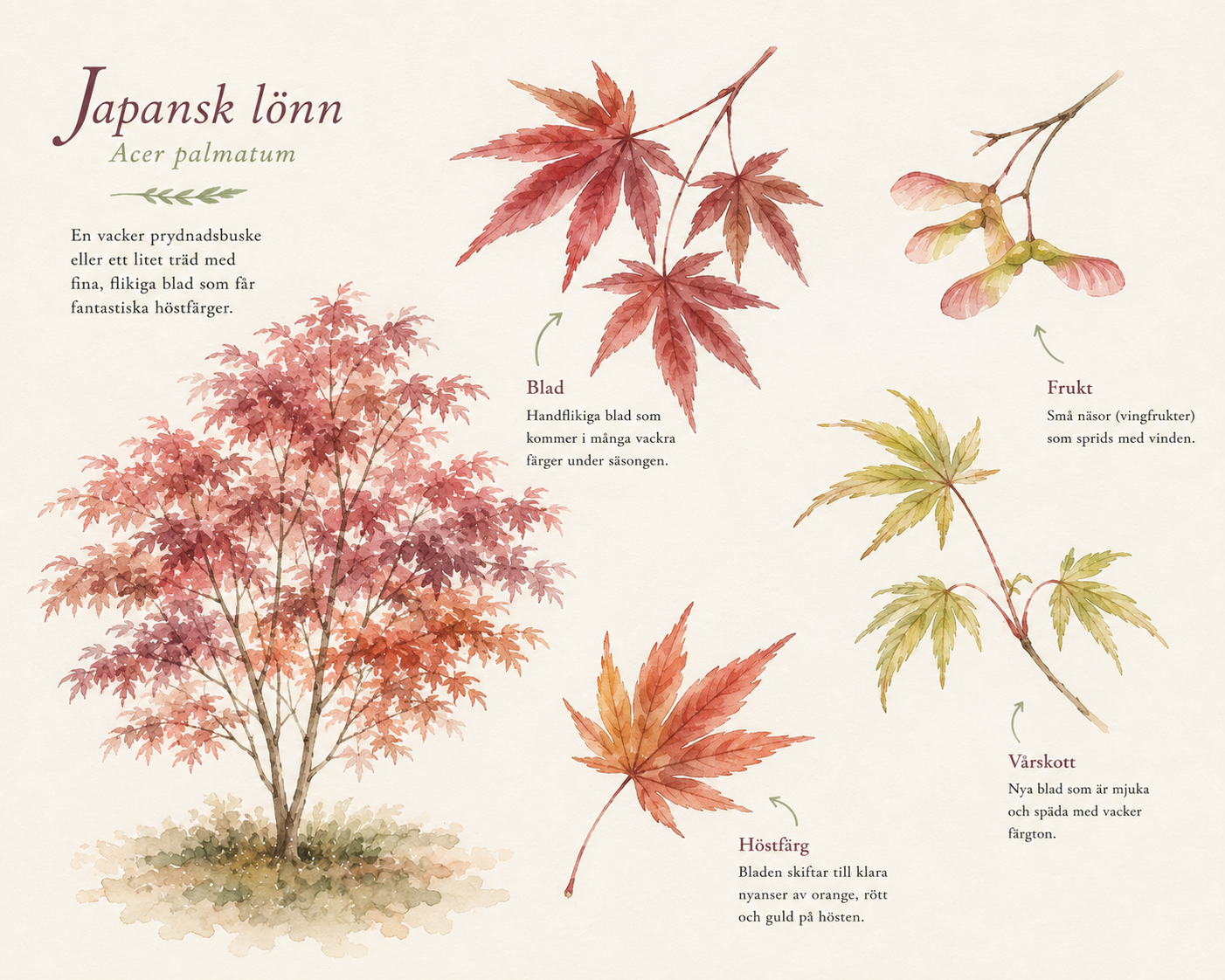
Japanese maple (Acer palmatum) grows slowly, rarely passes three metres and peaks in October when the leaves turn red or orange. It is not difficult to grow, but it is fussy about where it stands. Two things account for most failures: wind and afternoon sun. Give it a sheltered spot in part shade and it stays for decades.
The position decides everything
Choose a spot with morning sun and shade in the middle of the day, ideally in the lee of a hedge, a fence or a house wall. The thin leaves dry out quickly in wind, and it is drying out, not cold, that produces the scorched edges.
Soil: humus-rich, free draining and slightly acidic, pH 5.5 to 6.5. Work in bark compost or leaf mould. Limy soil gives pale leaves.
Drainage: standing water kills the roots. On clay, raise the bed 20 to 30 cm.
Wind: avoid corners and gaps where the air funnels through. It is the most common reason people are disappointed with the plant.
Planting a Japanese maple
Plant in spring or early September, not in the middle of summer heat.
Dig a hole twice as wide as the root ball but no deeper. A tree set too deep sulks for years.
Mix the excavated soil with bark compost, about one third.
Water in with 20 to 30 litres, then mulch with 5 cm of leaves or bark, keeping it off the trunk itself.
Water every second week through the whole first season unless it rains.
Pruning: when you are allowed to cut
This is where most people go wrong. Japanese maple bleeds heavily if you cut in late winter or spring, when the sap is rising. The cuts heal poorly and the tree is weakened.
Cut in August or September instead, once the year's growth has finished but the weather is still mild. Midwinter, in full dormancy, also works.
Take little: at most a fifth of the crown per year.
Cut back to a bud or a branch: never leave stubs.
Leave thick old wood alone: large cuts rarely heal on a Japanese maple.
Aim for air, not shape: take out branches that cross each other or grow inwards.
Brown leaf edges and what they mean
Dry, scorched edges in July are the most common question about Japanese maple. The leaf cannot cope when evaporation runs faster than the roots can supply.
Windy position: the edges dry first on the side the wind comes from. Move the plant or shelter it with a hedge.
Dry root ball: common in pots and during the first two years in the ground. Water deeply once a week instead of a little every day.
Afternoon sun: red-leaved cultivars scorch first. Shade from midday onwards solves it.
Salt: a maple near a road that is salted in winter shows the same symptoms. Move the plant.
Scorched leaves look bad but do no lasting harm. The tree makes new ones next spring as usual.
Cultivars
| Cultivar | Leaf colour | Height in time | Position |
|---|---|---|---|
| Atropurpureum | Deep red-brown all summer | 3 to 4 m | Morning sun, shade at midday |
| Crimson Queen | Red, finely cut, weeping habit | About 1.5 m | Part shade |
| Osakazuki | Green, turns brilliant red in October | 3 to 4 m | Takes the most sun |
| Aureum (Acer shirasawanum) | Yellow-green | 2 to 3 m | Needs shade, scorches easily |
Choose by position first and colour second. Yellow-leaved cultivars scorch in sun, green-leaved ones take the most sun, and the red ones sit in between. The species is normally hardy to around minus 20 degrees, but young plants and anything in a pot take considerably less. Growth is 10 to 20 cm a year, so buy the size you want.
Japanese maple in a pot
Size: at least 40 litres, preferably 60. Change the compost every three to four years.
Winter: stand the pot against a wall, wrap it in bubble wrap or sink it into the ground. The top of the tree takes the cold, the roots do not.
Winter watering: check the compost once a month. Drying out over winter kills more potted maples than frost does.
Shoots from the rootstock
Almost every named cultivar is grafted onto a rootstock of plain green Acer palmatum. The graft union shows as a swelling a little way up the trunk.
Shoots that appear below that swelling, or straight out of the ground, belong to the rootstock. They grow faster than the cultivar and take over if left. Remove them as close to the base as you can, as soon as you see them.
Diseases
Japanese maple is otherwise healthy. The one serious problem is verticillium wilt, a soil fungus that makes a single branch wilt suddenly in midsummer while the rest of the tree looks fine. Cut into that branch and you see dark streaks in the wood.
There is no treatment. Cut the branch back into healthy wood, disinfect the saw between every cut and do not plant another maple in the same spot.
Aphids turn up on young shoots but do no lasting damage.
What to plant underneath
Surface roots mean grass struggles close to the trunk. Shade-tolerant perennials and spring bulbs work better and keep the ground covered. There are more suggestions in our article on perennials, and if you need shelter around the spot, a hedge is an alternative to a fence. To sow your own, look for part-shade species among our flower seeds.
For another tree with the same need for acidic soil and a sheltered position, read about magnolia.
Author: Emma Vogiatzi
Fact checked by Erik Hoekstra
Last updated 2026-08-31