
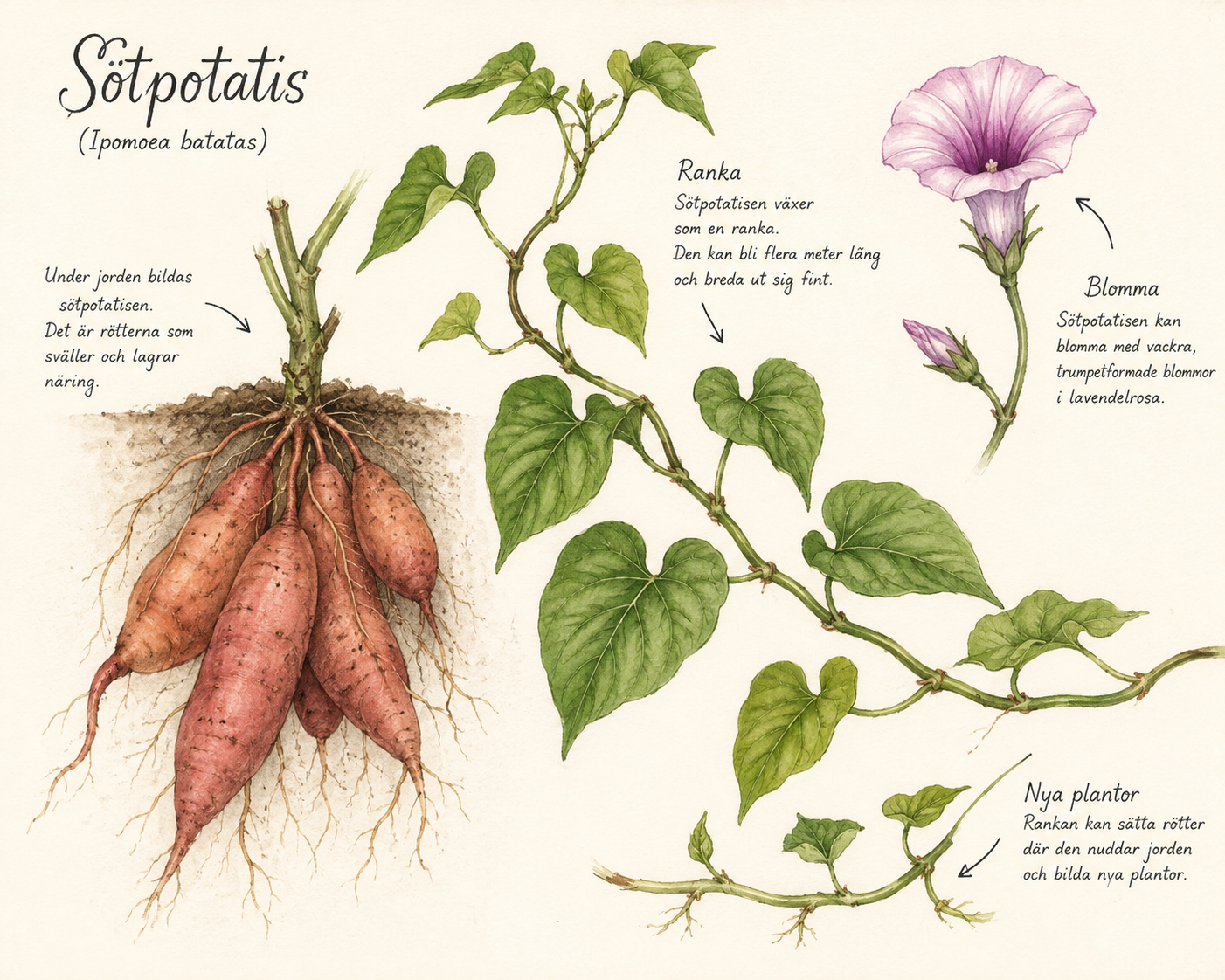
Sweet potato (Ipomoea batatas) is not a potato at all but a climber, closely related to morning glory. It is not grown from seed but from slips, and you can take those yourself from a tuber bought in a shop. It works in a cool climate, but the season has to start indoors in February or March and the plants need the warmest spot you have.
Take your own slips from a tuber
A sweet potato tuber pushes shoots if it gets warmth and moisture. It is the cheapest route to plants and it takes 4 to 6 weeks. Start in mid February if you want to plant out in early June.
Stand the tuber in water: push three toothpicks into the middle of the tuber and rest it on the rim of a glass so the lower half sits in water.
Give it warmth: keep the glass in good light at 20 to 25 degrees and change the water every other day.
Wait for the shoots: the first appear after 2 to 4 weeks. One tuber usually gives 5 to 10 shoots.
Twist the shoots off: when a shoot is 10 to 15 cm long, twist it away from the tuber.
Root the shoot: stand it in a glass of water with only the lowest leaves below the surface. Roots come in 5 to 10 days. Then pot it up until it is time to move outside.
Choose an organic tuber if you can. Conventional tubers are sometimes treated against sprouting and then push no shoots at all. If you are starting other crops indoors at the same time, our seeds for early sowing are worth a look.
Position, soil and planting
Sweet potato wants more warmth than most vegetables grown this far north. The best results come from a greenhouse, a polytunnel or a raised bed against a south facing wall. Soil temperature should be at least 15 degrees at planting, which in practice means early June in most places.
Soil: loose, sandy and free draining. The tubers grow badly in heavy clay.
Ridge: shape the soil into a ridge 20 to 25 cm high. It warms faster and gives the tubers room to swell.
Spacing: 30 to 40 cm between plants and 70 cm between rows.
Mulch: black landscape fabric over the ridge raises soil temperature by several degrees and keeps the weeds down.
In a container you need at least 40 litres of compost per plant. The same rule applies here as when you grow in a raised bed: depth matters more than surface area.
Care through the season
Watering: even moisture for the first six weeks while the roots establish. After that one thorough watering a week is enough.
Feeding: go easy on nitrogen. A lot of nitrogen gives long vines and small tubers. Pick a feed high in potassium instead, we go through the differences in our guide to plant nutrition.
The vines: they reach 2 to 3 metres and root wherever they touch soil. Lift them once a month so the plant puts its energy into the main tubers.
A drier finish: cut back on water for the last three weeks before harvest. It stops the tubers splitting.
Month by month
| Month | What you do |
|---|---|
| February | Stand the tuber in water to sprout |
| March | Twist off the shoots and root them in water |
| April | Pot up the rooted shoots indoors |
| May | Harden the plants off outdoors by day for 10 to 14 days |
| June | Plant out once the soil holds 15 degrees |
| July and August | Water, lift the vines, keep on top of weeds |
| September | Cut back on water and check tuber size |
| October | Harvest before the first frosty night |
Harvest and curing
Sweet potato needs 100 to 120 days from planting out to harvest. In practice you lift it in September or October, always before the first frost. Frost that blackens the leaves damages the tubers too, and a frosted tuber rots in store.
Dig carefully with a fork, well away from the plant. The skin is thin at lifting and every wound is an entry point for rot. Do not wash the tubers, just brush off the worst of the soil.
Then comes the step most people skip: curing. Keep the tubers for seven days at 25 to 30 degrees with high humidity, in a greenhouse for example, or in a box with a damp towel over it. During that week the skin heals and some of the starch breaks down into sugar. A cured sweet potato tastes sweet and keeps for months. An uncured one tastes floury and moulds within a few weeks.
Storage
Store dry and dark at 12 to 15 degrees. A cool bedroom or a cupboard against an outside wall works better than a root cellar. Below 10 degrees the tuber takes chilling injury: it goes hard in the middle, loses its sweetness and rots from the inside. So never put sweet potato in the fridge.
The leaves are edible
The foliage is edible and used as a leafy vegetable in much of the world. Pick the youngest shoots with their leaves, boil or fry them for a couple of minutes and use them like spinach. Take no more than a third of the foliage over the season, or the tubers suffer.
Common mistakes
Planting out too early: the plants sit still in cold soil and never get going. Wait until the soil holds 15 degrees even if the calendar says May.
Too much nitrogen: feed as you would for cabbage and you get a dense mat of vines and tubers the size of a finger.
Harvesting after a frost: a single frosty night is enough to make the tubers unfit for storage.
Skipping the curing: it is what decides whether the crop tastes sweet and keeps until spring.
Fridge instead of a cool room: the cold ruins the texture in a few days.
Varieties for short seasons
Choose by days to maturity first and colour second. Beauregard and Georgia Jet are among the earliest, both orange fleshed and around 100 days to maturity. Erato is a series bred for northern European conditions and comes in several colours. Murasaki has purple skin and white, drier flesh that suits the oven. Varieties needing 130 days or more rarely finish without a greenhouse.
If sweet potato works in your warmest spot, pumpkin usually does too. Seeds for that and other heat lovers are among our vegetable seeds.
Author: Emma Vogiatzi
Fact checked by Erik Hoekstra
Last updated 2026-08-27